

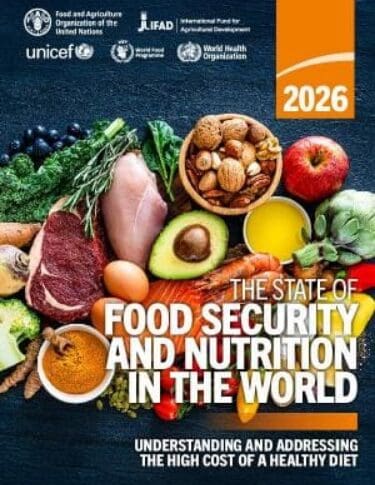
2026 Edition of the State of Food Security and Nutrition in the World Report
The recently released 2026 edition of The State of Food Security and Nutrition in the World (SOFI) report “estimates that 7.8 percent of the global population faced hunger in 2025, down from 8.1 percent in 2024 and 8.6 percent in 2022, confirming a sustained, albeit slow, improvement. This means that around 645 million people were affected by hunger in 2025, representing a reduction of nearly 14 million compared to 2024 and 43 million compared to 2022.” (WHO, 2026 and FAO et al., 2026)
“Despite global progress, recovery remains uneven across regions. Asia, together with Latin America and the Caribbean, has recorded steady improvements in recent years. In contrast, Africa is now home to approximately 309 million hungry people, compared with 292 million in Asia. Although Africa’s previously rising trend is beginning to stabilize, with the share of its population facing hunger decreasing from 20.3 percent in 2024 to 20.0 percent in 2025, the continent now has the highest number of hungry people in absolute terms amid a rapidly growing population.” (WHO, 2026)
“Broader measures of food access tell a similar story. In 2025, an estimated 25.8 percent of the global population (around 2.1 billion people) experienced moderate or severe food insecurity, meaning they were at times forced to compromise on the quality or quantity of the food they ate. This is down from 27.1 percent in 2024 and 28.7 percent in 2020 – equivalent to nearly 86 million fewer people than in 2024 and 135 million fewer than in 2020, though still above pre-pandemic levels.
Regional disparities remain stark. More than half of Africa’s population (56.6 percent) faced moderate or severe food insecurity in 2025, compared to 20.3 percent in Asia, 22.9 percent in Latin America and the Caribbean, and 8.7 percent in Northern America and Europe. Food insecurity also continues to be more prevalent in rural areas than in peri-urban and urban areas, while women remain disproportionately affected, although the gender gap narrowed slightly in 2025.” (WHO, 2026)
Slow progress on global nutrition targets
“The report highlights that global progress on maternal and child nutrition also remains insufficient to meet international commitments, including the 2030 nutrition targets.
Indicators such as child stunting, wasting, overweight, low birthweight and exclusive breastfeeding show only marginal improvements and progress is too slow to meet the targets. At the same time, anemia among women aged 15 to 49 years is worsening, while the prevalence of adult obesity shows a steady increase – from 12.1 percent in 2012 to 16.2 percent in 2024 – contrary to the target of halting its rise by 2025. Only 30.8 percent of children aged 6 to 23 months worldwide consume a minimally diverse diet and 150 million children under five years of age are still stunted.
Progress again varies significantly across regions. The prevalence of child stunting is declining in Africa and is on track to meet the 2030 target in Asia, while exclusive breastfeeding rates are improving across all regions where data is available. However, nearly all regions are experiencing widening gaps in addressing anemia among women, and child overweight is increasing rapidly in Oceania.” (WHO, 2026)
The cost of a healthy diet
“This year’s SOFI report takes a closer look at the cost of a healthy diet – the average minimum expenditure required to obtain locally available foods that meet energy and most nutrient requirements. According to FAO and WHO, a healthy diet is one that is adequate, balanced, diverse, and moderate.
The report underscores that costs remain a major constraint to achieving SDG 2 (Zero Hunger), although lowering such costs alone will not be sufficient to improve dietary quality and nutrition outcomes.” (WHO, 2026)
“In 2025, the average global cost of a healthy diet rose to 4.28 purchasing power parity (PPP) dollars per person per day, up from 3.44 PPP dollars in 2021 and 2.94 PPP dollars in 2017, with the highest levels recorded in Latin America and the Caribbean (4.91 PPP dollars). At the same time, the number of people unable to afford a healthy diet has declined – from 2.97 billion (37.4 percent of the global population) in 2021 to 2.69 billion (32.7 percent) in 2025.
However, this trend masks significant regional disparities. In Africa, affordability worsened markedly, with 66.6 percent of the population unable to afford a healthy diet in 2025 – more than double the levels observed in Asia and in Latin America and the Caribbean.” (WHO, 2026)
“Healthy diet costs vary widely across regions due to structural differences in agrifood systems. Animal source foods, fruits and vegetables account for the largest share of costs, while starchy staples contribute relatively little. Animal source foods are the largest contributor to the cost of a healthy diet in Africa, whereas vegetables represent the largest share in Latin America and the Caribbean.” (WHO, 2026)
“Food value chains are a major determinant of prices. Post-farmgate activities account for 70 to 75 percent of what consumers pay, with up to 40 percent of total costs arising in processing, logistics and wholesale. Improving efficiency in these segments is therefore critical, particularly for lowering the cost of perishable, nutrient-rich foods.
Reducing the cost of a healthy diet requires context-specific policy responses that expand the supply of nutritious foods while lowering structural costs across agrifood value chains. This includes investments in infrastructure, research and development, irrigation and cold chains, alongside reforms in subsidies, trade facilitation and regulatory frameworks.” (WHO, 2026)
“Targeted interventions that boost productivity, reduce losses and promote sustainable practices can simultaneously improve nutrition outcomes, strengthen resilience and support climate goals.
The work that lies ahead over the years to 2030 is immense. However, a world in which a healthy diet is no longer out of reach for nearly one in three people is a world worth building,” the report argues.” (WHO, 2026)
As noted above, the newly released report, The State of Food Security and Nutrition in the World 2026, also reiterates the importance of addressing the high costs of a healthy diet (WHO, FAO et al., 2026)
High Costs of a Healthy Diet
As noted by David Laborde at the FAO (in the Agrifood Economics and Policy Division, [ESA]):
“While the global average cost of a healthy diet reached PPP $4.28 per day in 2025, this single number masks massive regional disparities….
The reality is that the cost of nutritious food is driven by structural, 𝗹𝗼𝗰𝗮𝗹𝗶𝘇𝗲𝗱 𝗯𝗼𝘁𝘁𝗹𝗲𝗻𝗲𝗰𝗸𝘀 𝗮𝗻𝗱 𝗻𝗼𝘁 𝗷𝘂𝘀𝘁 𝗴𝗹𝗼𝗯𝗮𝗹 𝗰𝗼𝗺𝗺𝗼𝗱𝗶𝘁𝘆 𝗺𝗮𝗿𝗸𝗲𝘁𝘀.
Here is why the price of a healthy diet varies so drastically depending on where you live:
𝗟𝗮𝘁𝗶𝗻 𝗔𝗺𝗲𝗿𝗶𝗰𝗮 𝗮𝗻𝗱 𝘁𝗵𝗲 𝗖𝗮𝗿𝗶𝗯𝗯𝗲𝗮𝗻 (𝗟𝗔𝗖): 𝘛𝘩𝘦 𝘪𝘯𝘵𝘦𝘳𝘯𝘢𝘭 𝘓𝘰𝘨𝘪𝘴𝘵𝘪𝘤𝘴 𝘉𝘰𝘵𝘵𝘭𝘦𝘯𝘦𝘤𝘬, LAC faces the highest average cost of healthy diet (CoHD) in the world at 4.91 PPP dollars per day.
The main culprit? Exceptionally expensive vegetables. Severe logistical friction and poor midstream efficiency disproportionately inflate the retail price of highly perishable produce before it even reaches the consumer.
𝗔𝗳𝗿𝗶𝗰𝗮: 𝘛𝘩𝘦 𝘓𝘪𝘷𝘦𝘴𝘵𝘰𝘤𝘬 𝘊𝘩𝘢𝘭𝘭𝘦𝘯𝘨𝘦 𝘐𝘯 𝘈𝘧𝘳𝘪𝘤𝘢, animal-source foods (like meat and dairy) are by far the most expensive food group, with nearly 70% of countries falling into the highest cost tier globally. This is driven by low baseline productivity, high feed costs, and a lack of veterinary services, compounded by massive physical food losses due to weak cold chains.
𝗔𝘀𝗶𝗮: 𝘛𝘩𝘦 𝘙𝘢𝘤𝘦 𝘈𝘨𝘢𝘪𝘯𝘴𝘵 𝘵𝘩𝘦 𝘊𝘭𝘰𝘤𝘬, Fruits are the highest-cost food group in Asia. This is heavily tied to supply chain inefficiencies. Because fruits are highly perishable, the lack of packhouses, inadequate cold storage, and weak rural-urban transport links lead to massive post-harvest losses, driving up the retail price of the surviving fruit.
𝗛𝗶𝗴𝗵-𝗜𝗻𝗰𝗼𝗺𝗲 𝗥𝗲𝗴𝗶𝗼𝗻𝘀: 𝘛𝘩𝘦 𝘞𝘢𝘨𝘦 𝘋𝘪𝘷𝘪𝘥𝘦 𝘐𝘯 𝘌𝘶𝘳𝘰𝘱𝘦, Northern America, and Oceania, starchy staples and animal-source foods are structurally cheap due to decades of policy support and capital-intensive systems. However, fresh produce remains expensive. Why? Because fruits and vegetables are highly labor-intensive to harvest and cannot be so easily mechanized, making their prices highly sensitive to the high wages in these economies.
𝗧𝗵𝗲 𝗟𝗮𝗻𝗱𝗹𝗼𝗰𝗸𝗲𝗱 𝗣𝗲𝗻𝗮𝗹𝘁𝘆 𝗚𝗲𝗼𝗴𝗿𝗮𝗽𝗵𝘆 plays another cruel trick: Landlocked Developing Countries face import logistics costs that are 79% higher than coastal nations in the same region.
𝗧𝗵𝗲 𝗧𝗮𝗸𝗲𝗮𝘄𝗮𝘆: Because the drivers of food costs vary so drastically, there is no universal “silver bullet” to fix the problem.”
Lowering the cost of a healthy diet requires highly targeted, region-specific interventions. (Laborde, July 17, 2026)
References
FAO, IFAD, UNICEF, WFP, and WHO. The State of Food Security and Nutrition in the World 2026. Understanding the high cost of a healthy diet. July 21, 2026. Rome. Available at: https://openknowledge.fao.org/items/7eb22402-860f-4212-922f-55941aed4a27
Laborde D. Agrifood Economics and Policy division (ESA), FAO. LinkedIn Post. July 17, 2026.
World Health Organization (WHO). UN report: Global hunger levels ease for third consecutive year as regional disparities persist. July 21, 2026. Geneva. Available at: https://www.who.int/news/item/21-07-2026-un-report–global-hunger-levels-ease-for-third-consecutive-year-as-regional-disparities-persist
Tags: