

Shift to healthy, sustainable diets would reshape global agriculture: New research
New research published in Nature (July 15, 2026) concludes that transforming global food systems would benefit both population and planetary health, but farmers need support to adapt to fundamental changes (Gibson et al., 2026; London School of Hygiene & Tropical Medicine, 2026).
More specifically, the authors found that, “[f]ollowing recommendations to shift to healthier diets, improve farm productivity and halve food waste, could reduce global agricultural land use by up to 6% by 2050 and lead to a 42% decline ($630 billion) in global livestock production value compared to 2020.
Implementing the changes by 2050 would also lead to an estimated 70% ($274bn) decrease in the production value of ruminant animals (beef cattle, sheep, and goats) and 400 million fewer ruminant animals globally compared to 2020. In contrast the global value of vegetable, fruit, nut and legume production would increase by 57% ($890bn)….” (London School of Hygiene & Tropical Medicine, 2026)
[Furthermore], “the new analysis shows that following the 2025 EAT-Lancet Commission recommendations could also see agriculture related net-CO2 emissions from land-use change fall by 85% by 2050 compared to 2020 levels.” (London School of Hygiene & Tropical Medicine, 2026).
Lack of affordability and access to the foods that are recommended in the EAT-Lancet planetary health diet are discussed in this new research article, particularly for people residing in low and middle-income countries (LMICs). For example, the authors of this new research note that:
“Another impediment is consumer behaviour, which in our scenario assumed a costless consumer preference shift towards healthy diets. In reality, there are challenges to changing consumer behaviour including questions of accessibility and affordability, as well as engaging with broader food cultures and individual tastes that all contribute to dietary choices54. Although the challenges are immense and raise serious questions over the feasibility of achieving such changes by 2050, the potential of substantial positive change should not be discounted, for example through social tipping points55 or health innovation (for example, GLP-1 (ref. 56)).”
“This study does not explicitly contend with questions of consumer affordability, but some studies have assessed that a current EAT–Lancet diet could be more affordable for many in high-income countries but less affordable for many in lower-middle and low-income countries57. However, recent modelling suggests that an EAT–Lancet diet achieved by 2050 alongside reductions in FLW [food loss and waste] and projected per capita incomes rising faster than food prices, could be less expensive globally on average than BAU [business as usual] projected diets58 and, in a similar vein, we find that (producer) prices would be lower relative to BAU [business as usual] projections.”
“The global food systems transformation explored here fundamentally breaks with several historical trends (for example, on land use, and agricultural production and its value). Such a transformation would pose substantial political economy challenges with costs that are often concentrated (for example, the livestock sector) and benefits more diffuse (for example, general improvement of public health). Bold policy decisions in the present can shape and shield who wins and who loses in such a food systems future.” (p. 7) (Gibson et al., 2026)
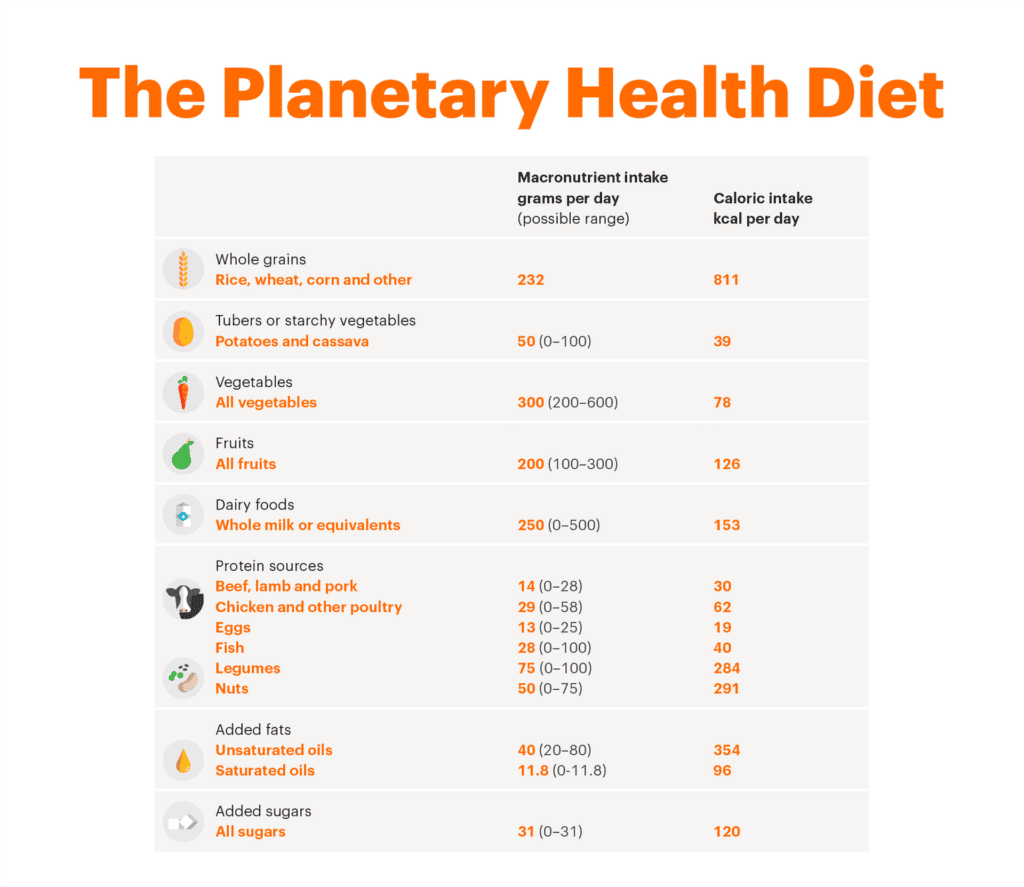
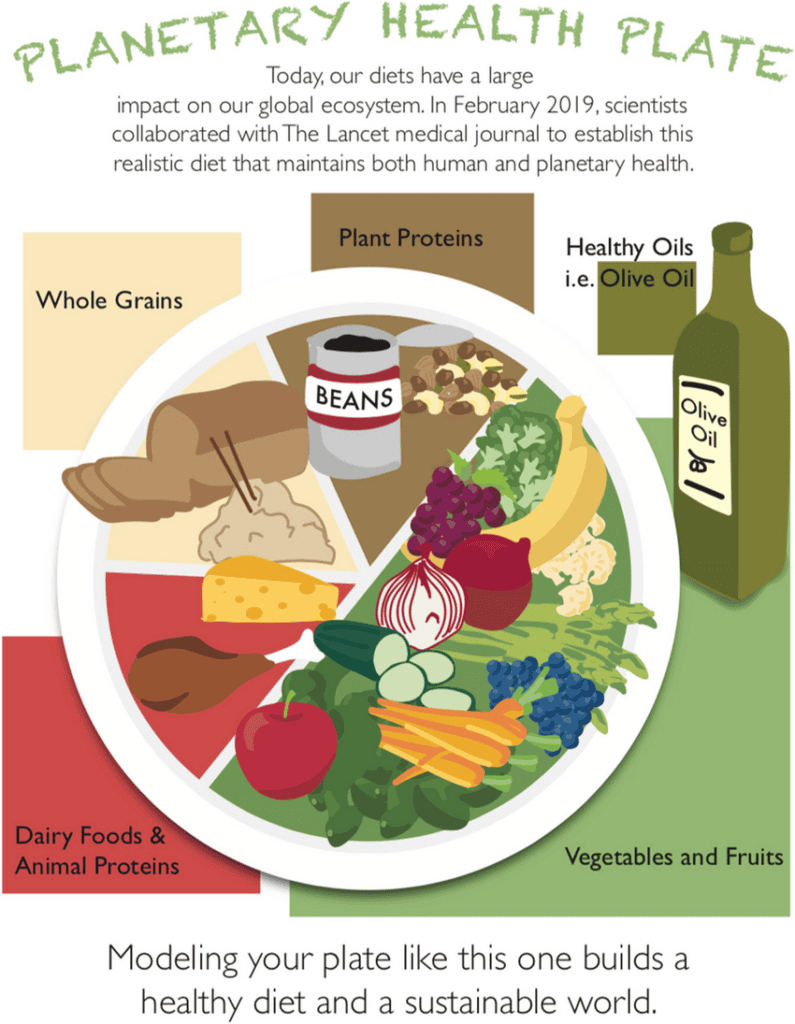
See below for more information on the individual food/dietary recommendations for the EAT-Lancet planetary health diet as well as a visual representation of this diet via The Planetary Health Plate.
The EAT-Lancet planetary health diet
References
Gibson, M., Sundiang, M., Mason-D’Croz, D. et al. Food systems transformation would reshape global agriculture. Nature; 2026. DOI: 10.1038/s41586-026-10775-2
Shift to healthy, sustainable diets would reshape global agriculture. London School of Hygiene & Tropical Medicine. July 15, 2026. Available at: https://www.lshtm.ac.uk/newsevents/news/2026/shift-healthy-sustainable-diets-would-reshape-global-agriculture
Tags: